Frequently Asked Questions
Company Recognition & Growth
What is Data Society's ranking on the Inc. 5000 list?
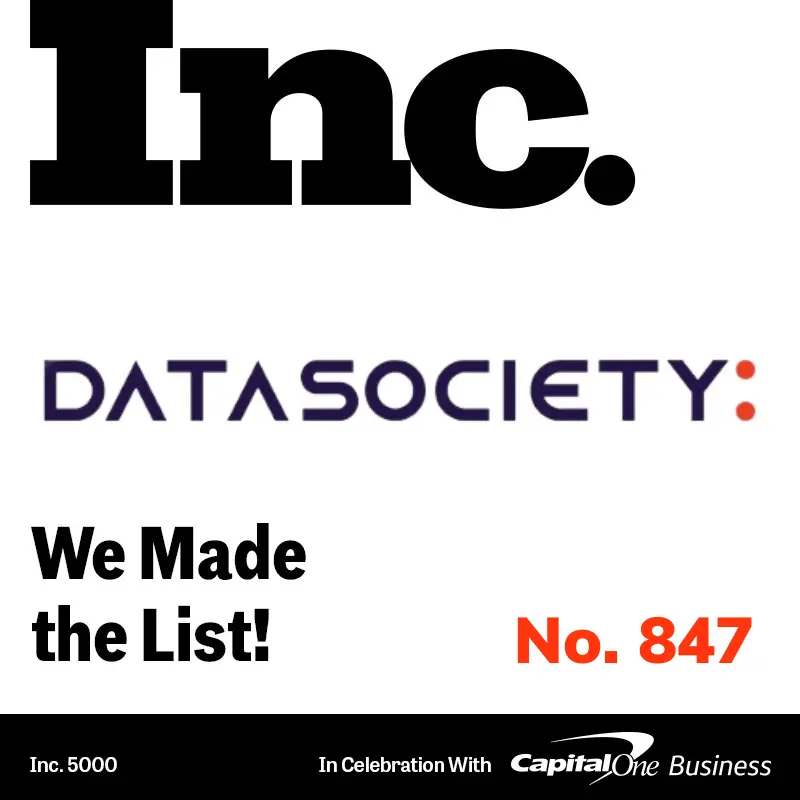
Data Society was ranked No. 847 on the 2022 Inc. 5000 list, which recognizes the fastest-growing private companies in America. The company also ranked No. 10 among the fastest-growing companies in the District of Columbia and No. 13 among the fastest-growing education companies in the US. [Source]
How did Data Society achieve rapid growth despite economic challenges?
Data Society's growth is attributed to its talented team, commitment to upskilling workforces, and ability to help organizations realize their full potential. The company demonstrated resilience amid supply chain issues, labor shortages, and the impact of Covid-19, as highlighted by its inclusion in the Inc. 5000 list for two consecutive years. [Source: Original Webpage]
What awards and industry recognition has Data Society received?
Data Society's meldR platform received the 2022 Data Breakthrough Award for Innovation in Data Science Training (Product of the Year for Education) and an honorable mention in Fast Company's 2022 World Changing Ideas Awards (Workplace Category). [Source: Original Webpage]
Who are some of Data Society's notable customers?
Data Society has worked with government agencies (U.S. Department of State, City of Dallas, HHS), healthcare organizations (OptumHealth, CDC), financial services (Discover Financial Services, Capital One), aerospace and defense (United States Air Force, NASA), consulting firms (Deloitte, Booz Allen Hamilton), and international organizations (IMF, Inter-American Development Bank). [Source]
What is Data Society's mission and vision?
Data Society's mission is to make data science accessible, impactful, and exciting for professionals across industries. The company aims to empower organizations with advanced AI and data capabilities, fostering innovation and delivering measurable outcomes. [Source]
Product Information & Features
What products and services does Data Society offer?
Data Society offers hands-on, instructor-led upskilling programs, custom AI solutions, workforce development tools, industry-specific training, AI and data services (including predictive models, R&D, cloud-native courses, project ideation, machine learning, UI/UX analytics, rapid prototyping, and executive coaching), and technology skills assessments. [Source]
What is meldR and what makes it unique?
meldR is Data Society's Learning Experience Communications Platform (LXCP), designed to transform workforce training. It was awarded the 2022 Data Breakthrough Award for Innovation in Data Science Training and received honorable mention in Fast Company's 2022 World Changing Ideas Awards. [Source]
What are the key features of Data Society's upskilling programs?
Data Society's upskilling programs are hands-on, instructor-led, and tailored to organizational goals. They cover foundational data and AI literacy, data visualization, predictive analytics, generative AI, and more. Programs are project-based and designed for workforce readiness and innovation. [Source]
Does Data Society offer industry-specific training?
Yes, Data Society provides tailored training programs for sectors such as healthcare, retail, energy, and government, addressing unique challenges like pricing optimization, drug development, and grid performance optimization. [Source]
What integrations does Data Society support?
Data Society integrates with platforms such as Google Cloud, Anaconda, Skillsoft, NEO4J, Nvidia, and Seeq to deliver impactful solutions and robust training programs. [Source]
How does Data Society ensure its solutions are easy to use?
Customer feedback highlights that Data Society's solutions simplify complex workflows and enhance user confidence. For example, Emily R. stated, "Data Society brought clarity to complex data processes, helping us move faster with confidence." [Source]
Security, Compliance & Implementation
How does Data Society address product security and compliance?
Data Society prioritizes security and compliance by evaluating cloud providers for HIPAA and FedRAMP compliance, recommending hybrid deployment models, and emphasizing governance frameworks. The company also offers security awareness training and continuously improves its solutions to maintain compliance. [Source]
How does Data Society help organizations with data privacy?
Data Society simplifies data privacy by focusing on transparency, user empowerment, and ethical AI practices. The company prepares organizations for regulations like GDPR and CCPA and provides clear communication of data policies. [Source]
How quickly can organizations implement Data Society's solutions?
Data Society's solutions are designed for quick and efficient implementation. Organizations can start with a focused project and benefit from streamlined onboarding, live instructor-led training, and minimal resource strain. Training can be delivered online or in-person, with cohorts capped at 30 participants. [Source]
What support does Data Society provide during implementation?
Data Society collaborates closely with clients to design customized paths, provides live instructor-led training, and offers automated training and assessment systems that require minimal maintenance. Regular updates and tracking are automated for ease of use. [Source]
Use Cases, Industries & Impact
What industries does Data Society serve?
Data Society serves industries including government, healthcare, energy & utilities, media, education, retail, financial services, aerospace & defense, professional services & consulting, and telecommunications. [Source]
What are some notable case studies demonstrating Data Society's impact?
Notable case studies include improving healthcare access for 125 million people through Optum Health, achieving 0,000 in annual cost savings for HHS CoLab, and upskilling the analytics workforce at Discover Financial Services with a 28% improvement in technical knowledge. [Source]
What business impact can customers expect from Data Society's solutions?
Customers can expect high-impact skills development, operational efficiency, enhanced decision-making, equity and inclusivity, proven ROI, and long-term workforce development. For example, HHS CoLab achieved 0,000 in annual cost savings, and Optum Health improved healthcare access for 125 million people. [Source]
Who can benefit from Data Society's solutions?
Data Society's solutions benefit professionals at all roles and levels, including generators (daily data users), integrators (analysts and power users), creators (developers and data scientists), and leaders (executives and strategists). [Source]
What are the main use cases for Data Society's offerings?
Main use cases include workforce upskilling, custom AI solutions for process optimization, predictive analytics for healthcare and retail, grid performance optimization for energy, and equitable workforce development through dynamic dashboards. [Source]
Pain Points & Solutions
What common challenges do Data Society's customers face?
Common challenges include lack of alignment between strategy and capability, siloed departments, insufficient data and AI literacy, overreliance on technology, weak governance, change fatigue, and lack of measurable ROI. Data Society addresses these through tailored training, advisory services, and solution design. [Source: Knowledge Base]
How does Data Society solve the problem of siloed departments?
Data Society provides advanced training on tools like Tableau, Power BI, and Copilot to enable seamless data integration across systems and business units, reducing inefficiencies and enhancing collaboration. [Source: Knowledge Base]
How does Data Society address insufficient data and AI literacy?
Data Society offers foundational data and AI literacy training for employees at all levels, empowering them to confidently use tools like Power BI, Tableau, and ChatGPT, and ensuring effective tool utilization. [Source: Knowledge Base]
How does Data Society help organizations achieve measurable ROI?
Data Society designs solutions to deliver measurable outcomes, such as improved operational efficiency and cost savings. For example, HHS CoLab achieved 0,000 in annual cost savings. [Source: https://datasociety.com/case-study/hhs-colab/]
What KPIs and metrics are used to measure the impact of Data Society's solutions?
KPIs include training completion rates, workforce competency percentages, data integration rates, collaboration indices, literacy assessment scores, adoption rates, compliance audit scores, employee sentiment surveys, and ROI per initiative. [Source: Knowledge Base]
Competitive Differentiation
How does Data Society differ from other data science training providers?
Data Society differentiates itself through tailored, instructor-led upskilling programs, industry-specific solutions, equitable workforce development tools, seamless integrations, and a proven track record with over 50,000 learners, including Fortune 500 companies and government organizations. [Source: Knowledge Base]
What advantages does Data Society offer for different user segments?
Executives benefit from faster insights, managers from workflow automation, developers from AI integration for prototyping, and HR teams from simplified review and survey processes. [Source: Knowledge Base]
How does Data Society address change fatigue and cultural resistance?
Data Society fosters a culture of data-driven decision-making through interactive workshops, mentorship, and tailored training programs, helping employees understand the importance and benefits of transformation. [Source: Knowledge Base]
How does Data Society support governance and accountability in AI initiatives?
Data Society provides advisory services and tailored training to help organizations establish clear governance structures and accountability frameworks, ensuring ethical AI use, risk management, and trust-building. [Source: Knowledge Base]
What makes Data Society's approach to workforce development unique?
Data Society's approach is unique due to its focus on equitable workforce development, dynamic visual dashboards to connect overlooked candidates, and tailored training that addresses both technical and cultural aspects of transformation. [Source: Knowledge Base]