You’re Already Paying for the Room
There is a moment that happens at almost every leadership event, and once you start noticing it, you really cannot unsee it. It shows up quietly, without disruption, which is exactly why it is so easy to overlook.
This shift usually happens mid-second day: energy levels out, attention softens, and the room moves from active to passive reception.
Nothing is wrong. Speakers and content are strong, but the experience falls short of active learning.
And this is where most teams fall short. The experience is usually built to share information, not to shift how people actually work, and those outcomes are not the same. If the goal ends with awareness, that is often where the impact ends as well.
The Investment No One Questions
Organizations invest a significant amount to bring people together like this, and it is not just about flights and hotels. It is time, attention, coordination, and the decision to step away from everything else that is competing for focus.
For a brief window, you have something incredibly difficult to create in a distributed environment. You have your team physically present, aligned in attention, and thinking about the same challenges simultaneously.
That kind of setting is harder to come by than people realize, and its value extends well beyond the event itself. It gives teams a chance to slow down, get on the same page, and actually understand one another in a way that rarely happens during the normal pace of work.
The challenge is that most leadership events are built to share direction, not to build and practice skills. People walk away with a clear sense of what matters, but not always with the tools or confidence to approach their work any differently once they are back in it.
That is often where the return starts to level off. Alignment on its own does not move anything forward if it never turns into action.
Where Momentum Stalls
The gap shows up almost immediately after the event ends. People leave feeling energized, connected, and clear on the strategy or direction, which feels like success in the moment.
But by the next Monday morning, very little has actually changed. The same systems are in place, the same workflows are followed, and the same habits take over without much resistance.
This becomes even more obvious when AI is part of the conversation. Leaders talk about transformation, urgency, and opportunity, while teams quietly try, and often struggle, to translate those ideas into something practical.
When there is no clear way to apply what was learned, people fall back on what they already know. It is not a lack of effort; it is simply that they have not had the chance to practice something new in a real way.
Over time, that disconnect grows. The organization keeps talking about change, but daily habits stay the same, and whatever momentum was built starts to fade sooner than expected.
A Different Way to Use the Room
Teams seeing real movement ask not just what to deliver, but what people can do differently after the event.
That one shift changes how everything gets designed. It shifts the focus from presentations to participation, aiming to spark action in the room rather than just understanding.
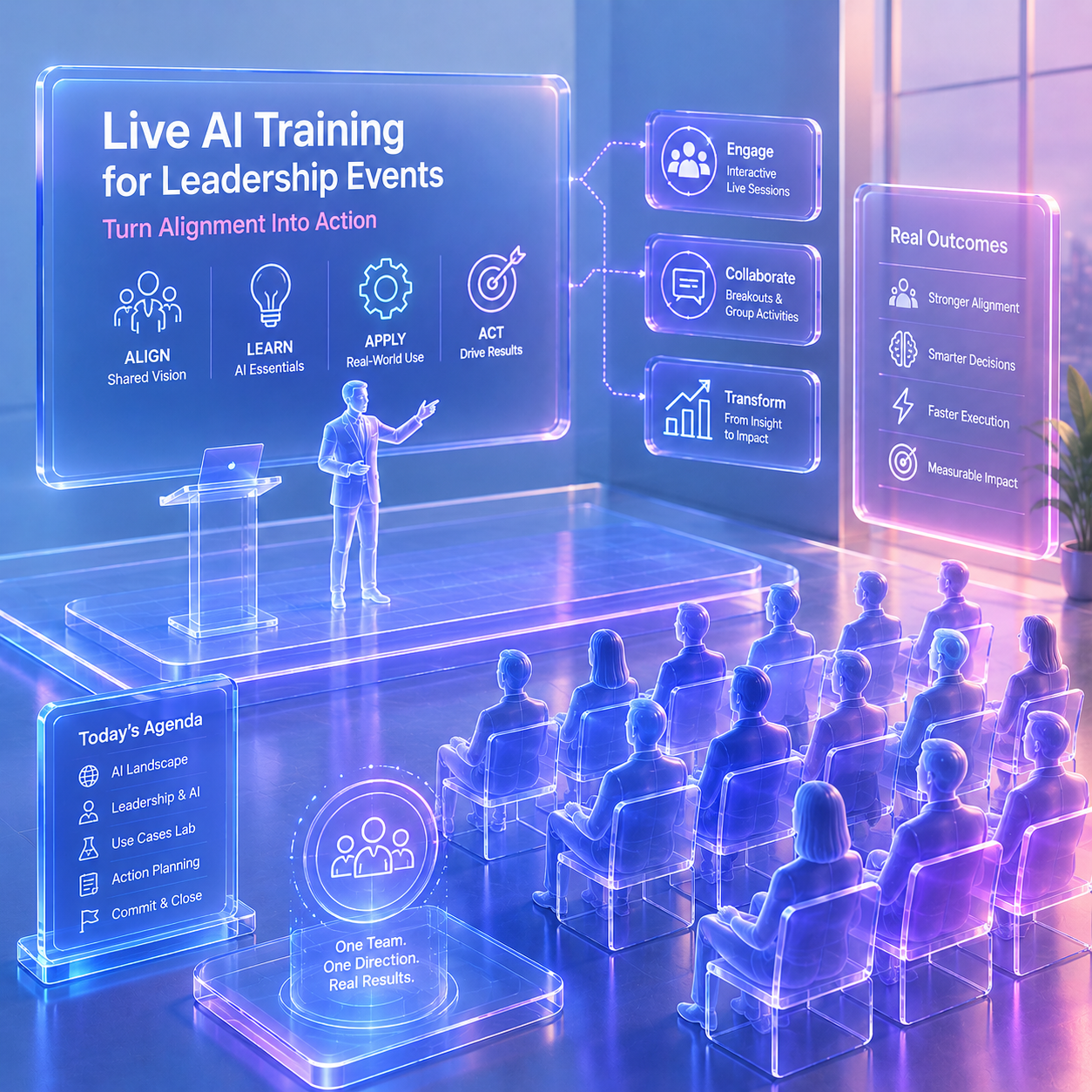
This is where live, in-person AI training starts to change the dynamic. The room becomes a place where work actually happens, not just a place where ideas are shared.
People are not just listening to what AI could do. They are working through how it applies to their workflows, their data, and their decisions in real time.
That changes how people engage. When the expectation is to do, not just absorb, the entire tone of the event shifts.
What Happens When People Actually Do the Work
When teams are given the space to actually do the work, the difference is immediate. Engagement increases when people solve problems that are real to them, not hypothetical examples.
Analysts begin testing use cases tied directly to their data. Managers explore how decisions change when AI is introduced into their process.
Executives can see how strategy connects to execution in a tangible way. The distance between idea and action starts to shrink in real time.
There is a different kind of energy in the room when people are building something together. It becomes collaborative, practical, and focused in ways that are hard to replicate in traditional formats.
Most importantly, people leave with something practical to build on and create momentum.
Why In-Person Still Wins
There is a reason this works differently in person. Being physically together supercharges collaboration, shortens decision cycles, and enables breakthrough solutions on the spot.
Questions get answered in real time. Challenges get worked through on the spot instead of being pushed into future meetings.
People can see how others approach the same problem, which creates shared understanding. That shared experience becomes a foundation teams can actually build on.
Instead of rolling out ideas in phases, you build alignment and capability simultaneously. Everyone leaves with the same language, the same tools, and the same starting point.
That is what makes adoption possible. It is not just about knowing what to do; it is about knowing how to do it together.
What Changes After the Event
The most important shift shows up after the event ends. That is where most leadership events either create real momentum or lose it entirely.
When teams have already practiced ideas, they don’t leave with buried notes—they return with proven concepts and clear action plans to implement immediately.
They have already taken the first step, which makes the second step easier. That changes how quickly they move once they return to their normal environment.
Conversations move from abstract ideas to practical decisions. Teams discuss what they’re doing, not just what’s possible.
That shift is small on the surface, but it changes everything about how progress happens.
You Already Have the Hardest Part
You already have the most difficult pieces in place. You have the time, the people, and the attention, all in one room.
Most organizations stop at alignment because it feels like progress. And to some extent, it is.
Alignment without action rarely changes anything. Fast-moving teams build capability in the moment.
That’s where we focus. We design and deliver live, instructor-led AI training at your leadership event. We customize it for your organization and engineer the course to drive immediate, visible results. The main benefit: your team leaves not only aligned but also with the skills and solutions they can implement right away.
Final Thoughts
If you are already bringing your team together, this is your opportunity to make that time work harder. You have already made the investment; now it is about what you do with it.
Let’s turn your next event into something your team actually uses when they get back to work. The main benefit: they will change how they operate, immediately applying what they learned, not just remembering it.
Book time with Scott, and we will walk through how this fits into your event without adding complexity. It is simpler than most teams expect, and the impact shows up faster than they think.
FAQ
Live AI training is a hands-on, instructor-led experience delivered during an in-person event where teams actively apply AI to their real workflows.
People stay more engaged, conversations flow naturally, and teams can work through real problems together as they arise.
It works best when everyone is involved, from frontline staff to executives, because learning together makes it easier to actually move in the same direction afterward.
It usually fits into what is already planned without much disruption and can be shaped around your specific goals.
Teams walk away having already applied what they learned, with ideas tested and a clearer sense of what to do next.