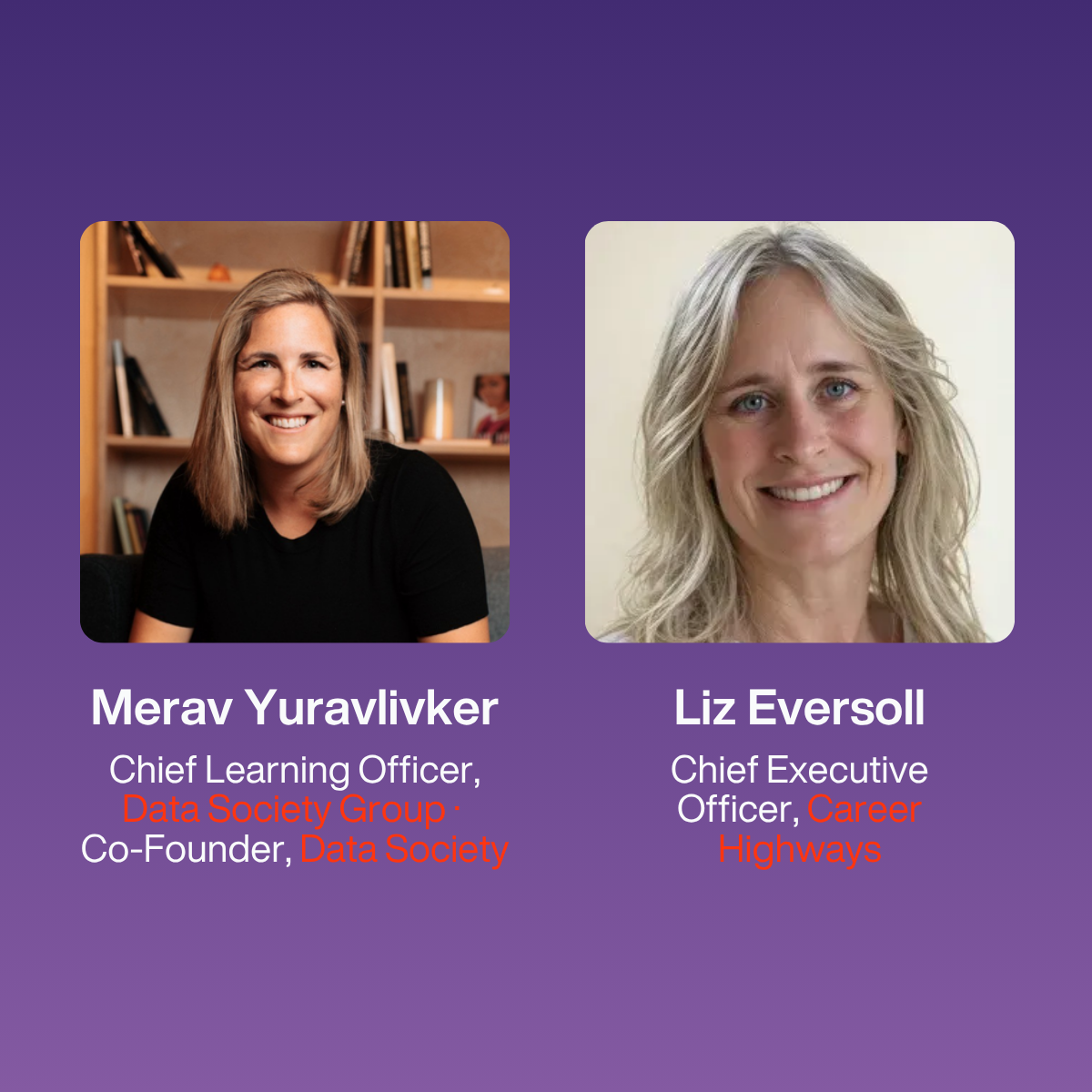
When leaders talk about AI transformation, the conversation almost always starts with tools: which platform to buy, which model to pilot, which process to automate first. But in a recent Data Society fireside chat, Merav Yuravlivker, Co-Founder and Chief Learning Officer at Data Society, and Liz Eversoll, Co-Founder of Career Highways, made the case that the real transformation starts somewhere else entirely: with a clear-eyed understanding of the skills already sitting inside your organization.
That focus on people wasn’t incidental. “We’re a big believer in people,” Merav said early in the conversation. “I’m never the smartest person in the room, and we want everybody to come with their experiences and their ideas and their skills to contribute. We’re only as strong as they are.” That belief anchored a wide-ranging conversation about why so many companies struggle to see their own talent clearly, and what it takes to fix that.
The biggest gap isn’t AI. It’s visibility.
Ask Liz where leaders struggle most right now, and the answer isn’t a lack of ambition or a lack of tools. It’s a lack of visibility. “It’s very hard to have visibility, both for the employee to see what opportunities exist and what their skills match to across the organization, and for leaders to see what the inventory is of their skills and their skills talent,” she explained.
Becoming a skills-based organization has historically been a massive lift. Mapping every role to the skills it requires, and connecting that map to training and development, has taken large companies anywhere from six months to three years. Liz described skills as “the connective tissue” between talent, jobs, and training, without which there’s no real way to model or measure a workforce that represents, in most companies, half the P&L.
The payoff for doing that work is concrete. In one 3,500-role organization Liz’s team worked with, the data showed that just 15 skills were strategic enough to show up across 60% of all roles. That’s the kind of insight, she said, that tells a company exactly where to invest its learning and development budget instead of guessing.
Context is king
If there was one idea that anchored the whole conversation, it was this: technical skills matter, but business context is what actually separates organizations that get value from AI from those that don’t. “People with business context” was the top gap Liz sees right now: people who understand the work well enough to judge whether the output of an AI tool is actually good.
Merav connected this directly to what she’s seeing across the industry. “The most successful implementations are around people who have had 15 to 20 years of experience. They already understand the nuances. AI can help us get there faster, but you have to be very careful about how you use it.” She framed it this way, borrowing an idea from a conversation she’d had with a VP of data: AI extends your reach, but the farther along you already are, the farther that extension goes.
Soft skills came up right alongside business context: teamwork, collaboration, human judgment. As Liz put it, transforming a workplace with AI is mostly process improvement work, and that requires people who can build frameworks and work well with others, not just people who know a platform.
Stop hiring for the role. Start hiring for the skills.
One of the most practical pieces of advice in the conversation was about how leaders should think about employees whose roles are shifting because of AI. Liz’s answer: stop getting hung up on the job description. “Really focus on what that person’s skill set is and not what the role or the job definition says.” Job postings look backward. They rarely capture what a business will actually need in six, twelve, or eighteen months, especially now.
That shift in thinking carries real financial stakes, which is the same reasoning behind Career Highways’ approach to internal mobility for employers. Liz noted that hiring externally typically costs 15-20% more than moving existing talent internally, on top of a six-to-eighteen-month ramp-up period. When a person with deep institutional knowledge walks out the door, that knowledge is genuinely hard to replace. Merav has seen the same instinct play out with Data Society’s own partners: rather than retraining people from scratch, some organizations are giving employees a real look at other roles across the company, a “day in the life” of a data engineer or a data analyst, for example, so people can see and choose a path forward instead of being shown the door.
Transparency is what makes all of this work, both leaders agreed. Liz shared the story of a recruit who walked away from an interview process the moment he realized the company couldn’t show him a career pathway, something his previous employer had made simple. It’s not a small thing to employees, either: “This is always the top five for the last 10 years in employee surveys,” Liz said, “transparency and opportunity in the organization and how do I get there.”
Measuring skills without measurement fatigue
Fireside chat attendee Jean-François Goldstyn raised the question a lot of leaders are quietly wrestling with: how do you assess skills objectively, without relying purely on self-reported, subjective ratings?
Neither Liz nor Merav pretended there’s a single clean answer. Liz described a system where importance and competency levels are defined for each skill, and employees and managers work together to assess and adjust those ratings over time. Merav added a distinction worth sitting with: skill, tool usage, and confidence are three different things, and each needs its own way of being measured. Her team leans heavily on practical, project-based demonstrations of skill rather than long assessment surveys, both because it avoids assessment fatigue and because it produces something more convincing than a self-rating: proof that someone can apply a skill in the actual context of the business.
Where to start
For any leader listening and thinking “we have none of this in place,” Liz offered a clear starting point: pick one high-stakes function or department and start mapping the skills it actually requires. It’s manual work, and pairing it with hands-on training aligned to the skills you’ve identified is what turns the exercise into measurable capability rather than a spreadsheet exercise. Liz was candid that very few organizations land this well on their own. But the entry point doesn’t have to be complicated. “Give us a list of your roles,” she said, describing how her team builds out skills pathways in a matter of weeks, “and then you can put those pathways in front of employees so that they can build their skills inventory. Once you have two sides of the equation, the box opens up and all the goodies come out.”
That’s really the thesis of the whole conversation. AI isn’t going to replace the need to understand your people; it’s raising the cost of not understanding them. The organizations that navigate this well won’t necessarily be the ones with the fanciest tools. They’ll be the ones that know, in detail, what skills they already have, what they’ll need next, and how to connect the two.
Want the full conversation? Watch the replay of “Your People Are the Strategy: Rethinking Talent in the AI Era” to hear Merav Yuravlivker and Liz Eversoll dig into skills mapping, AI readiness, and internal mobility in full.