The community of practice—an age-old resource for collaborative progress—may be enjoying increasing relevance in today’s workplaces. Communities of practice can serve several of the emerging needs of today’s organizations and their employees, which are reflected in several statistics:
- 87% of companies reported that they either have a skills gap or expect to have a skills gap in the next few years, according to a survey cited in a McKinsey Quarterly report published in January 2021,
- A PwC Pulse Survey found that 77% of executives identified hiring and retaining talent as the most critical growth driver for 2022.
- Some estimates project that poor employee retention rates will cost the US $430 billion annually by 2030.
In addition, there is evidence that employees who have experienced the isolation of remote work are seeking ways to capture a sense of community with their colleagues. This sentiment appears to be true even for workers who report a preference for continuing to work from home. In a recent survey of employees about their perceptions of remote work, 44% expressed fear that it would diminish their sense of community and connection to coworkers. This is a valid concern, as those concerns are important for both individual workers and the workplace.
The workforce trends mentioned above reveal an appetite for both learning and connection. Collaborative efforts that unite colleagues for joint and individual development can help satisfy these needs. They have the power to engage. And the appeal of such shared ventures has only increased since pandemic lockdowns spawned a protracted period of physical distancing and reliance on digital interactions for large portions of the population. These challenges, and other issues at the forefront of employers’ current workforce concerns, can be addressed by forming vibrant communities of practice.

What is a Community of Practice?
While communities of practice have existed in various forms across time and space, a clear definition of the concept gained widespread recognition with the publication of Situated learning: Legitimate Peripheral Participation, by Jean Lave and Etienne Wenger, in 1991. Wenger has further expanded on the concept in numerous subsequent works, defining communities of practice as, “groups of people who share a concern or a passion for something they do and learn how to do it better as they interact regularly.” Organizations can help employees establish and maintain these collectives by providing them the resources and time to meet, develop mentorship relationships, and maintain ongoing communications about their shared goals and challenges. In addition, facilitating digital interaction in these communities through online dialogue and virtual meetings and events allows for a contemporary approach to collective gathering and establishes a culture of reciprocity.
How Communities Drive Workforce Learning
Organizations that encourage forming communities of practice bolster their employee training efforts with the benefits of social learning. In his book Communities of Practice: Learning, Meaning, and Identity, published in 1998, Wegner explains his theory of social learning, making a compelling argument for the educational benefits of collective experiences. In the book’s introduction, he notes, “We are social beings. Far from being trivially true, this fact is a central aspect of learning.”
There is evidence that fostering environments where workers have access to these benefits will help organizations meet the current demands of hiring, retaining, and upskilling their teams. Statistics, such as the following, support this notion:

Meanwhile, other risks in these categories may be managed through manual processes or simple desktop applications. Financial institutions continue to rely on spreadsheets for many sensitive and risk-relevant business processes. For example, an institution’s determination of all the rules and regulations that apply to it, which is fundamental to a complete understanding of its compliance risk, often resides in a simple spreadsheet. For an institution with many varied responsibilities, such a spreadsheet will be cumbersome to maintain and prone to error. Of course, moving from a spreadsheet to another type of application is no guarantee against mistakes. To the extent possible, the u003ca href=u0022https://datasociety.com/case-study/idb-infrastructure-risk-mitigation/u0022 target=u0022_blanku0022 rel=u0022noreferrer noopeneru0022u003erisk assessmentu003c/au003e should be driven by automated data pipelines, analytics, and reporting, designed with input and awareness from all stakeholders to ensure the timeliness of the information and visibility of changes.
- According to a SHRM article, 61% of employees cited opportunities for upskilling as an important reason to stay in their jobs. 71% said training and development increase job satisfaction, and 57% indicated a desire to update their skills.
- A Fringe article about employee retention reports that mentorship programs increase retention by 50%.
- A Forbes article offers similar statistics, citing a study that found the retention rate for mentees (72%) and mentors (69%) was much higher than the rate for employees who didn’t participate in a mentorship program (49%).
Workforce learning is at once a driver and an outcome of communities of practice. While peers working toward common goals have a natural tendency to coalesce around their shared struggles and successes, the mutual support they provide in the process tends to help them absorb and retain new knowledge. Moreover, there are several additional advantages that workplace communities of practice can bring to organizations:
- Learners experience the educational benefits of mutual support and guidance in settings where they will be most comfortable seeking help.
- Open communication about work helps reduce or eliminate the duplication of efforts.
- Sharing experiences across departments enables employees to identify common challenges and discover globally applicable solutions, helping break down counterproductive silos.
- Because practitioners are in the best position to determine the knowledge that will best serve them in their work, dialogue across teams and roles can generate ideas for new ways of doing things and the skills that would be most valuable to them.
- The exchange of ideas about experiences and observations supplements formal training by providing another dimension of knowledge.
- Opportunities for upskilling and sharing work-related needs across roles can help organizations make better hiring decisions and attract a wider pool of candidates.
- Workplace communities fill a need for connection that has increased since the onset of the pandemic.
The meldR Learner Experience: Uniting Learning With Community Through meldR LXCP
The meldR Learning Experience and Communication Platform (LXCP) fosters the development of workplace communities of practice. Among meldR’s powerful features currently in the platform are elements that facilitate engaging learner experiences:
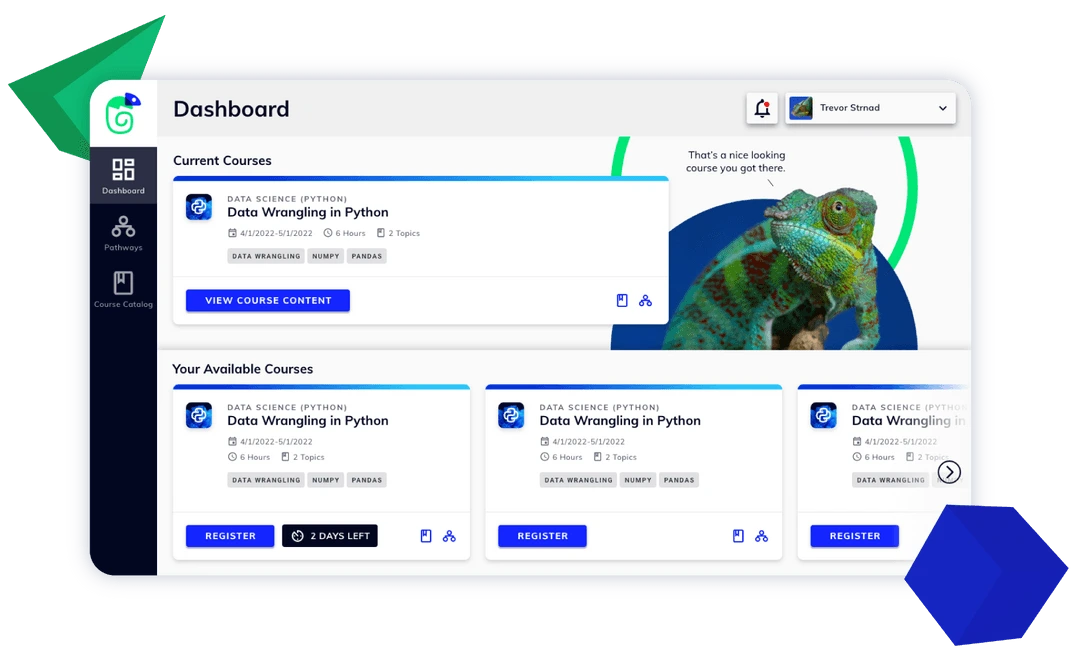
Learner Dashboard – meldR’s learner dashboard helps users become active participants in charting their training experience, offering convenient views of their course registrations, learning pathways, and the entire catalog of courses available through meldR. By using the
Course Request Button – Learners can notify their supervisors of additional courses they would like to add to their options and partner with their L&D departments in shaping their professional development. This feature encourages learners to take shared ownership of their upskilling journeys, helping them learn more quickly by allowing them to pursue areas of study that are of most interest to them.
Learner Profiles – By enabling learners to develop their organizational personae via profiles, learners can connect and collaborate, highlighting their latest professional achievements and relevant skills.
Single Sign-On (SSO) – SSO authentication eliminates the need for users to toggle between applications, streamlining the process of managing courses and progressing through learning pathways.
Roadmapped Features – to further engage the learner and the L&D Supervisor for shared understanding, additional features will be released soon and will become the mainstay of fostering the community of practice with collaboration and communications elements.
Communication Integration – The LXCP seamlessly integrates with email, social media, and calendar platforms into a single environment to support communication, collaboration, and coordination of events and other group activities.
Badging and Certification – An important component of the learner profile is the opportunity for learners to share their accomplishments. meldR’s badging and certification features highlight student successes, providing encouragement and motivation for their colleagues and offering supervisors current information about the proficiencies available within their workforce.
Mentoring – meldR’s mentorship feature matches students seeking additional guidance in their learning to suitable mentors and facilitates the scheduling of virtual mentoring sessions.
Gamification – Good-natured competition is a time-honored incentive for effort. Gamification helps students take advantage of one of the most effective mechanisms available through social learning, which is the ability to gauge individual knowledge through comparison to the knowledge of other cohort members.
In the introduction to Communities of Practice: Learning, Meaning, and Identity, Wenger listed the components of learning according to his theory of social learning:
- Learning as doing (practice)
- Learning as belonging (community)
- Learning as experience (meaning)
- Learning as identity (becoming)
These values, at the heart of communities of practice, have the power to increase fulfillment, motivation, and collaboration among members. Fertile ground for collegial exchanges of ideas and concerns, communities of practice can support many of today’s most urgent organizational efforts to attract, retain, and upskill employees. In addition, communities of practice foster individual and collective development and interpersonal connection, driving important outcomes in workforce learning and engagement.
Learn more about meldR
A Social Learning LXCP (Learning Experience Communications Platform) built for today’s Healthcare L&D department’s growing demands for upskilling its employees with Data Science training. Our social learning platform, meldR, goes beyond the LMS or LXP. We created an atmosphere where both the learner and supervisor will have a full view of the entire learning ecosystem.
Providing:
- Technology Transformation
- Community of Practice
- Talent Success Development