
Frequently Asked Questions

About the Bias Risk Detection App & Google/CFPB Partnership

What is the purpose of the Bias Risk Detection App developed by Data Society, Google, and the CFPB?

The Bias Risk Detection App, developed in partnership between Data Society, Google Cloud, and the Consumer Financial Protection Bureau (CFPB), is designed to empower borrowers by identifying potential bias in lending processes. The app enables both consumers and regulators to detect, report, and address discriminatory lending practices, supporting fair lending and expanding credit access to those negatively affected by data bias. [Source]

How does the 'Loans Like Me' app help consumers detect bias in lending?

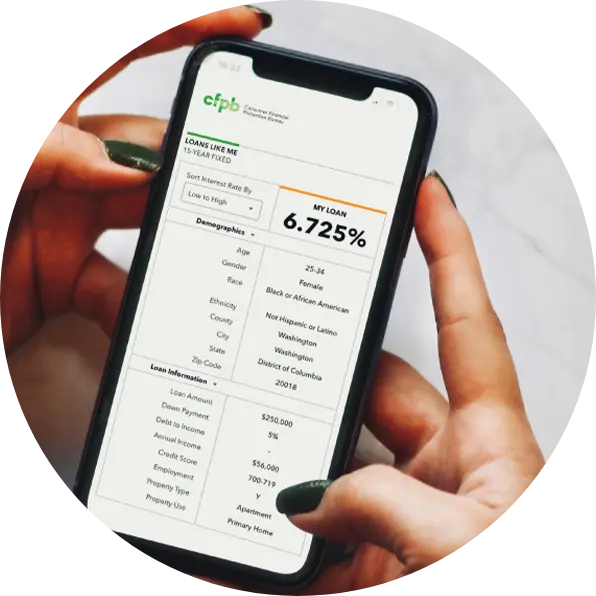
The 'Loans Like Me' app democratizes Home Mortgage Disclosure Act (HMDA) data, allowing consumers to compare quoted interest rates and mortgage details against similar loans. It predicts the probability of bias (low, medium, or high) and enables users to report possible bias directly to the CFPB or request assistance in finding a fairer rate. The dashboard also informs users about factors influencing interest rates, including comparable loan details and historical bias trends. [Source]

What data sources does the Bias Risk Detection App use to analyze lending discrimination?

The app leverages four main data sources: HMDA public data, census public data, social media and news sources (for soft indicators and reputation), and private data pipelined from the CFPB. These sources enable the app to provide a robust, transparent analysis of lending discrimination at multiple levels. [Source]

How does the app's algorithm detect and predict bias in lending?

The algorithm clusters consumers based on financial factors impacting interest rates, then compares them to peers within subgroups. It incorporates reputation scores, soft indicators, and HMDA LAR data to forecast discrimination risk at the institution, county, state, and national levels. This enables both consumers and regulators to identify and address bias proactively. [Source]

How does the app support regulators in identifying and addressing lending bias?

The app overlays real-time consumer data on maps of historic credit deserts and automatically flags financial institutions across regions when biased or discriminatory practices are detected. This allows regulators to take targeted remedial actions quickly, rather than waiting for annual data submissions. [Source]

What impact does the Bias Risk Detection App have on consumers and the CFPB?

For consumers, the app provides self-advocacy tools and transparency, helping them find fairer lending options. For the CFPB, it enables a shift from annual to real-time monitoring, allowing for agile, relevant decisions and strengthening the agency's role as a resource for fairness in lending. [Source]

What federal priorities does the Bias Risk Detection App address?

The app supports the Biden administration's executive order 13985, which directs federal agencies to evaluate and reduce bias in their operations. By providing tools for bias detection and reporting, the app helps agencies comply with these mandates and improve equity in federal services. [Source]

How does the app empower consumers to advocate for themselves?

The app gives consumers access to clear, comparable data on interest rates and lending practices, as well as the ability to report bias and request assistance. This transparency and direct reporting capability enable consumers to advocate for fair treatment and seek better lending options. [Source]

What role did Brllnt play in the development of the Bias Risk Detection App?

Brllnt, a creative agency, collaborated with Data Society and Google Cloud to design the user-friendly interface of the 'Loans Like Me' app, ensuring accessibility and ease of use for both consumers and regulators. [Source]

How does the app use real-time data to improve regulatory oversight?

The app collects and overlays real-time consumer reports on lending practices, allowing regulators to identify emerging patterns of bias and take action promptly, rather than relying on retrospective annual data submissions. [Source]

What is the significance of using both public and private data in the app?

By combining public data (HMDA, census, social media) with private CFPB data, the app provides a comprehensive, multi-faceted view of lending practices and potential bias, enhancing the accuracy and reliability of its risk assessments. [Source]

How does the app's dashboard help consumers understand their loan options?

The dashboard presents key details from comparable loans, highlights factors influencing interest rates, and visualizes historical bias trends, giving consumers actionable insights to make informed decisions and advocate for fairer rates. [Source]

What are the main benefits of the Bias Risk Detection App for financial institutions?

While the app primarily empowers consumers and regulators, financial institutions can benefit from increased transparency and the opportunity to address and correct biased practices proactively, improving compliance and public trust. [Source]

How does Data Society's expertise contribute to the success of the Bias Risk Detection App?

Data Society brings deep expertise in AI, data science, and government solutions, enabling the development of advanced algorithms and user-friendly tools that address complex regulatory and equity challenges in lending. [Source]

What is the long-term vision for the Bias Risk Detection App?

The long-term vision is to establish the CFPB as a key resource for fairness in lending by enabling ongoing, real-time monitoring and remediation of bias, ultimately promoting equity and transparency in financial services nationwide. [Source]

When was the collaboration between Google, CFPB, and Data Society announced?

The collaboration was announced on April 27, 2021. [Source]

How does the Bias Risk Detection App align with Data Society's broader mission?

The app exemplifies Data Society's mission to empower organizations and individuals with data-driven tools that foster equity, transparency, and innovation in critical sectors like government and finance. [Source]

Features & Capabilities

What products and services does Data Society offer?

Data Society offers a comprehensive suite of products and services, including hands-on, instructor-led upskilling programs, custom AI solutions, equitable workforce development tools, industry-specific training, AI and data services (such as predictive models and rapid prototyping), and technology skills assessments. These offerings are tailored to deliver measurable outcomes and foster innovation across industries. [Source]

What are the key capabilities and benefits of Data Society's solutions?

Key capabilities include tailored upskilling programs, advanced AI-powered solutions for industry-specific challenges, workforce development tools promoting inclusivity, measurable outcomes with tracked ROI, and long-term sustainability through responsible AI integration. These benefits help organizations bridge skill gaps, foster collaboration, and achieve strategic goals. [Source]

Does Data Society offer industry-specific training?

Yes, Data Society provides tailored training programs for sectors such as healthcare, retail, energy, and government, addressing unique challenges like pricing optimization, drug development, and grid performance optimization. [Source]

What technology skills assessments does Data Society provide?

Data Society offers technology skills assessments to evaluate and enhance workforce data science and AI capabilities, ensuring organizations can identify skill gaps and target development efforts effectively. [Source]

Use Cases & Benefits

Who can benefit from Data Society's solutions?

Data Society's solutions are designed for executives, managers, technical professionals, HR teams, and marketing teams across Fortune 1000 companies, government agencies, and industries such as healthcare, aerospace, financial services, and consulting. [Source]

What business impact can customers expect from using Data Society's products?

Customers can expect measurable outcomes such as cost savings (e.g., 0,000 annual savings in the HHS CoLab case study), improved workforce capabilities, operational efficiency, enhanced decision-making, and long-term sustainability through responsible AI adoption. [Source]

What industries are represented in Data Society's case studies?

Industries featured in Data Society's case studies include aerospace & defense, financial services, government, healthcare, professional services & consulting, and telecommunications. [Source]

How does Data Society ensure measurable outcomes for its clients?

Data Society ties every solution to clear business outcomes, tracking KPIs such as training completion rates, post-training performance improvements, and ROI. This ensures transparency, accountability, and alignment with client goals. [Source]

Pain Points & Solutions

What core problems does Data Society solve for organizations?

Data Society addresses challenges such as misalignment between strategy and workforce capability, siloed departments, insufficient data and AI literacy, overreliance on technology without human enablement, weak governance, change fatigue, and lack of measurable ROI. Solutions include tailored upskilling, data integration, governance policies, and change management support. [Source]

How does Data Society address fragmented data ownership and siloed departments?

Data Society provides data integration solutions and change management support to foster collaboration across departments, enabling scalable AI initiatives and reducing duplication of effort. [Source]

What KPIs and metrics does Data Society use to measure success?

Key metrics include training completion rates, post-training performance improvement, data integration rates, employee data literacy scores, adoption rates of new tools, compliance audit scores, change adoption rates, and ROI per initiative. [Source]

How does Data Society help organizations overcome change fatigue and cultural resistance?

Data Society offers leadership training, employee engagement initiatives, and change management support to address emotional and cultural resistance, ensuring smoother adoption of new technologies and strategies. [Source]

Implementation & Support

How long does it take to implement Data Society's solutions?

Data Society ensures a streamlined implementation process, allowing customers to get started quickly with minimal delays. Structured onboarding, installation calls, and tailored training programs help organizations integrate new systems efficiently. [Source]

What support does Data Society provide during and after implementation?

Data Society offers dedicated mentorship, interactive workshops, office hours, and real-time support through its Learning Hub and virtual teaching assistant, ensuring smooth integration and ongoing success. [Source]

How easy is it to start using Data Society's products?

With flexible delivery options (live online or in-person), hands-on installation support, and tailored training, organizations can quickly and easily onboard their teams with minimal disruption to daily operations. [Source]

Security, Compliance & Trust

What security and compliance certifications does Data Society hold?

Data Society is ISO 9001:2015 certified, demonstrating its commitment to internationally recognized quality management standards. This certification is especially significant for industries with strict regulatory requirements, such as government contracting. [Source]

How does Data Society ensure the security and compliance of its solutions?

Data Society's ISO 9001:2015 certification highlights its secure and compliant operations. Solutions are designed to align with industry-specific compliance requirements, providing peace of mind for organizations in regulated sectors. [Source]

Customer Experience & Proof

What feedback have customers given about the ease of use of Data Society's products?

Customers have praised Data Society for simplifying complex data processes. For example, subscriber Emily R. stated, "Data Society brought clarity to complex data processes, helping us move faster with confidence." [Source]

What is Data Society's track record in serving clients?

Data Society has served over 50,000 learners, including Fortune 500 companies and government organizations, demonstrating its credibility and effectiveness in delivering data and AI solutions. [Source]

Company Information & Vision

What is Data Society's mission and vision?

Data Society's mission is to help clients create a data-driven workforce and empower bold, new ideas, fostering innovation and operational efficiency. Its vision is to transform the way organizations operate by expanding its reach across Fortune 1000 companies and large government agencies. [Source]

When was Data Society founded and where is it headquartered?

Data Society was founded in 2014 and is headquartered in Washington, D.C. [Source]

Data Society, in partnership with Google Cloud, and creative agency, Brllnt, develops ‘Loans Like Me,’ a user-friendly application that enables the CFPB to improve fair lending practices.

Google and the CFPB to Empower Borrowers with Bias Risk Detection App 

Google and the CFPB to Empower Borrowers with Bias Risk Detection App
In its first 100 days, the Biden administration has made uncovering and eliminating bias across federal agencies a top priority. Executive order 13985 directs all departments to evaluate bias and return recommendations to reduce its impact. Bias is often hidden in the data that the federal government uses to make decisions and deliver critical services across the nation. 
While agencies begin the work of recognizing and reporting potential bias, Data Society, alongside Google Cloud developers and Brllnt designers, is already supporting the CFPB (Consumer Financial Protection Bureau) in that effort. The team developed “Loans Like Me,” a user-friendly CFBP tool to empower regulators and consumers with clear data. Loans Like Me enables the CFPB to improve fair lending practices and expand credit to those negatively affected by data bias.

User-Friendly Data

“Loans Like Me” is an AI-driven web app that democratizes HMDA (Home Mortgage Disclosure Act) data, enabling consumers to compare quoted interest rates and mortgage details against similar loans and detect the probability (low, medium, or high) of bias. Directly from the app, the user can report possible bias to the CFPB and request assistance to find a more fair rate. The app’s dashboard also informs the consumer of factors that could influence interest rates, including key details from comparable loans and historical bias in the data (e.g., an institution’s past lending patterns, or geographic trends, affecting individuals that objectively “look like them”). With easy access to this information, consumers have a firm foundation to advocate on their own behalf and find lenders with less propensity toward possible bias.

For regulators, Loans Like Me overlays incoming real-time data from consumers over a map of historic credit deserts and automatically flags financial institutions within and across geographic regions as automated calculations and comparisons reveal biased/discriminatory practices. With this tool, regulators are able to readily identify emerging or enduring bias and target remedial actions in short order, rather than awaiting annual submissions to identify issues retroactively.
Google and the CFPB to Empower Borrowers with Bias Risk Detection App

Innovative AI

Our solution is predicated on the use of four pillars of information and incorporating artificial intelligence to create a more robust and transparent solution for lending discrimination analysis that has the granularity to facilitate consumers and regulators across the agency. 

Our approach deconstructs a complex problem into its smallest building blocks and then addresses each through means of analysis of the following types of data sources:

  • HMDA public data
  • Census public data
  • Social media and news sources to determine soft indicators/reputation
  • Private Data pipelined from CFPB

We built an algorithm that clusters similar consumers based first on financial factors with the greatest impact on potential interest rates and compares them to peers within a subgroup using important features to predict the risk of discrimination. Finally, with reputation, soft score (externally derived), and HMDA LAR data incorporated the application can forecast discrimination risk of an institution and county- state-, and national level trends.

The Impact

In the hands of the consumer, this user-friendly platform powers the self-efficacy that brings equity closer to the norm, one deal at a time.  For the CFPB, moving from annual bank submissions to real-time consumer reports means understanding changing interest rates as they’re quoted, informing agile and relevant decisions. Long term, as an agency, such valuable tools help the CFPB strengthen its position as a key consumer resource for fairness in lending and beyond.

Data Society leads government agencies and global enterprises alike to understand, and then unleash, the unlimited potential of their data-driven workforce.


Don’t wanna miss any Data Society Resources?

Stay informed with Data Society Resources—get the latest news, blogs, press releases, thought leadership, and case studies delivered straight to your inbox.

Data: Resources

Get the latest updates on AI, data science, and our industry insights. From expert press releases, Blogs, News & Thought leadership. Find everything in one place.

View All Resources
  • The Setup: A Leadership Event Doing Exactly What It Should

    May 26, 2026

    Read more

  • Live AI Training for Leadership Events: Turn Alignment Into Action

    May 21, 2026

    Read more