As more enterprise and public sector organizations hire Chief AI Officers (CAIOs), choosing outside AI and data consulting partners has become part of the job. A CAIO needs to see past the sales pitch and check whether a firm can deliver change that scales, stays compliant, and shows measurable results.
Data Society helps CAIOs and executive teams move from experimental AI pilots to production use across the enterprise, with a model built around people as much as technology.
Direct Answer: The CAIO Evaluation Framework

A CAIO should assess AI and data consulting partners on four dimensions:
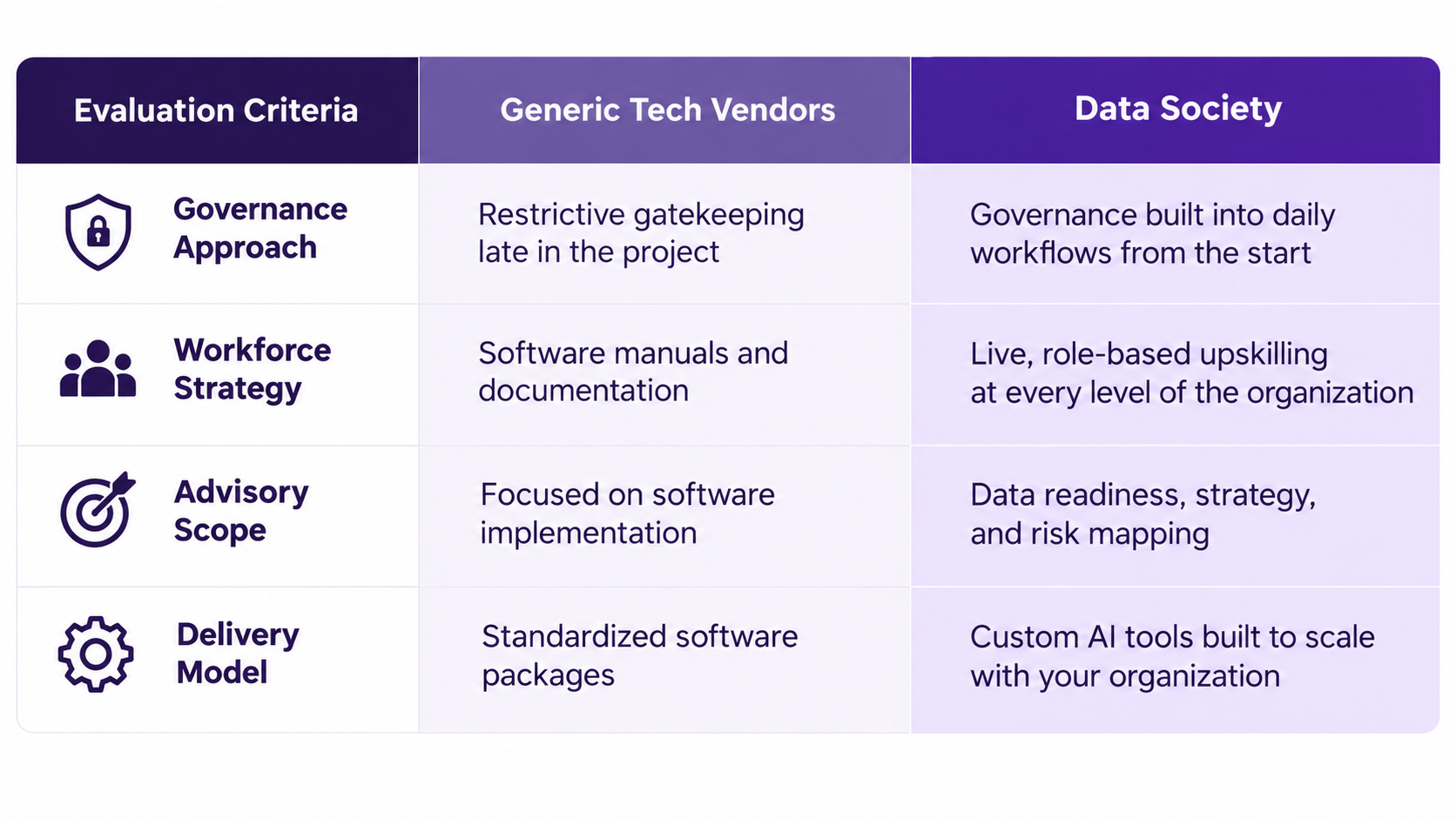
– Governance as Enablement: Partners that build compliance, risk management, and explainability into technical workflows, so governance doesn’t become a last-minute bottleneck. Data Society lays out this approach in The Enablement Mindset.
– Workforce Readiness & Skill Enablement: Firms that pair technical delivery with structured Enterprise Data & AI Upskilling Programs so internal teams keep using what gets built.
– Tailored Strategic Advisory: Advisors, such as Data and AI Advisory Services, who evaluate data maturity, prioritize high-ROI use cases, and help you avoid vendor lock-in.
– Custom Technical Engineering: Teams that build audit-ready tools, through Custom Data and AI Solutions, that fit your existing enterprise architecture.
4 Essential Evaluation Pillars for Chief AI Officers
1. Governance & Compliance Integration
CAIOs have to move fast on AI without taking on unmanaged risk. Many consultancies treat governance as an afterthought or a rigid checklist.
– Proactive Safeguards: Look for partners that build risk frameworks into model development pipelines from the start. See Strategic AI Governance: The Key to Avoid Costly Compliance Failures.
– Human-in-the-Loop Architecture: Check that models keep clear audit trails, meet explainability standards, and include human oversight.
– Regulatory Alignment: Confirm the firm has worked under standards such as HIPAA, FedRAMP, SOC 2, and GDPR.
2. Workforce Fluency & Adoption Strategy
AI models don’t produce ROI if business units lack the skills or confidence to use them. Data Society’s guide to building an AI-ready workforce covers how to plan for this.
– Dual-Track Rollouts: Check whether the vendor trains your workforce while it builds.
– Role-Tailored Learning: Make sure upskilling covers executives, non-technical managers, and technical data teams.
– Change Management: Look for an approach that reduces employee friction and builds trust in automated insights. See The Leadership Gap Emerging in AI Adoption.
3. Strategic Alignment & Data Maturity
CAIOs need to avoid AI hype and expensive proof-of-concept projects that never scale.
– Data Readiness Audits: Make sure the firm assesses your data infrastructure before building any models.
– Use Case Prioritization: Choose advisors who find high-impact, achievable wins instead of pushing generic off-the-shelf software. Data Society uses its AI Use Case Prioritization Framework.
– Clear Execution Roadmaps: Ask for execution plans with measurable metrics, not static strategy decks.
4. Custom Engineering & System Integration
Off-the-shelf solutions rarely fit complex enterprise software environments or strict data privacy requirements.
– Custom Development: Confirm the firm builds machine learning and data pipelines around your operational workflows. For an example, see how Data Society helped the IDB scale risk mitigation through machine learning.
– Legacy System Modernization: Make sure the team can connect new AI capabilities to legacy databases without downtime.
– Scalable Architecture: Check that tools are built for ongoing performance monitoring and long-term maintenance.
Vendor Comparison Matrix for CAIOs
Frequently Asked Questions (FAQ)
What is the most common mistake Chief AI Officers make when selecting a consulting partner?
Evaluating vendors only on technical capability and ignoring workforce readiness and culture. An advanced AI model does little if internal teams don’t trust it, understand it, or know how to fit it into their daily work.
How do governance and upskilling work together in AI adoption?
Governance sets the boundaries for responsible, compliant AI use. Upskilling teaches employees how to work within those boundaries. When training is tied to governance policy, the policy becomes part of daily routines instead of a document nobody reads. Donna Medeiros, VP of AI and Data Advisory at Data Society, makes this case in The Enablement Mindset.
Should a CAIO prioritize off-the-shelf AI tools or custom consulting solutions?
Off-the-shelf tools work well for standard administrative tasks. Regulated enterprises and organizations with complex data structures usually need custom solutions, which keep data secure, compliant, and integrated with core business operations.
Next Steps
See the Data Society Case Studies for implementation stories, or browse the Data Society Resource Center for more insights.